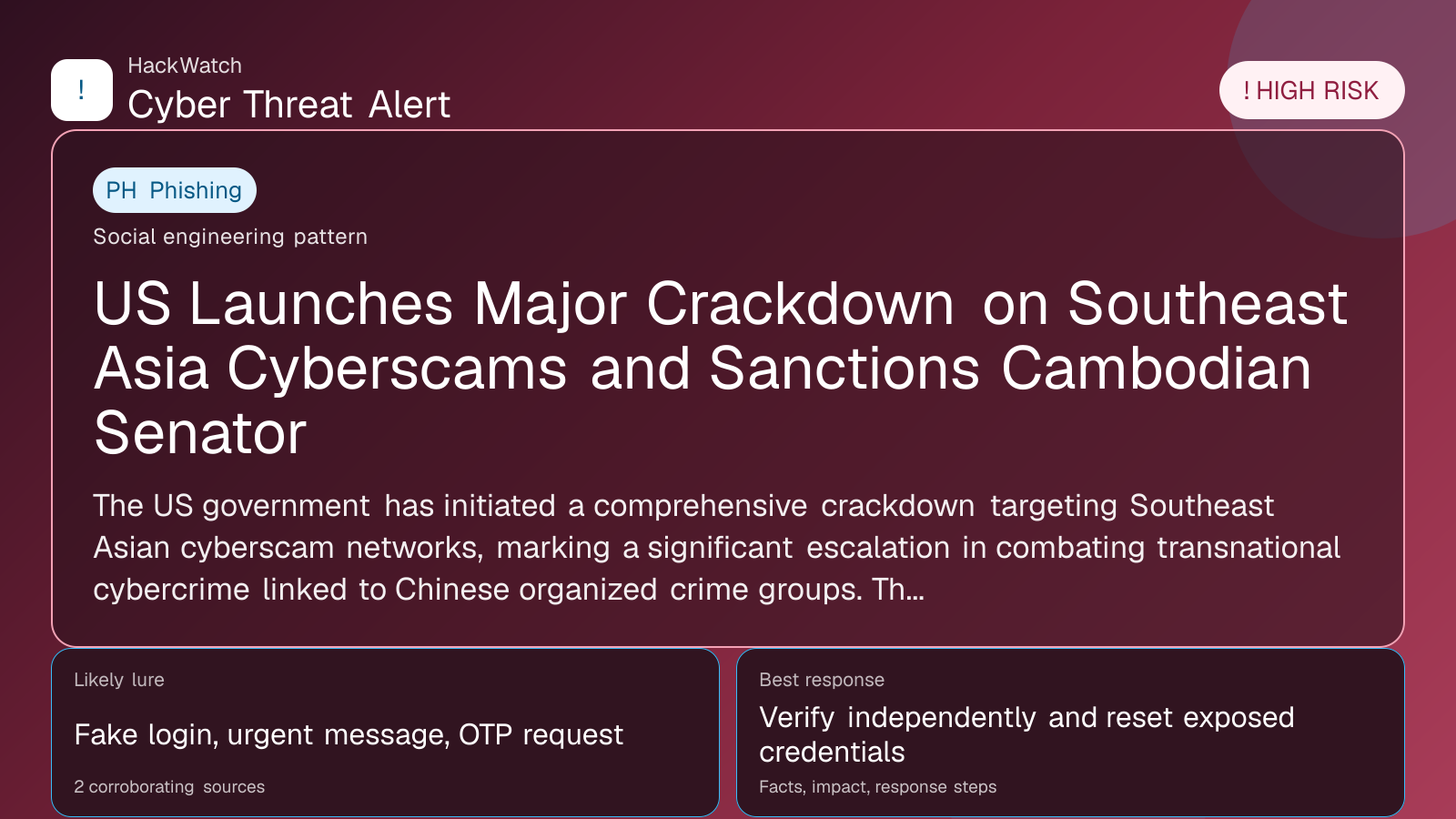
US Launches Major Crackdown on Southeast Asia Cyberscams and Sanctions Cambodian Senator
Verification-lure coverage focused on fake messages, cloned pages and account defense steps.
Trust note:This alert is maintained under HackWatch's editorial policy, with visible source records, a named responsible editor and a correction channel for disputed facts.
Review our editorial policy or send corrections to [email protected].
Active threat. The incident should still be treated as active until confirmed mitigation or patch adoption is verified.
The US government has initiated a comprehensive crackdown targeting Southeast Asian cyberscam networks, marking a significant escalation in combating transnational cybercrime linked to Chinese organized crime groups. This includes sanctions against a Cambodian senator implicated in facilitating these operations. This article consolidates multiple sources to provide a detailed analysis of the crackdown, its implications, and actionable guidance for individuals and organizations at risk.
What happened
In April 2026, U.S. authorities announced a sweeping crackdown on cyberscam operations rooted in Southeast Asia, particularly those linked to Chinese transnational organized crime. This initiative, described by U.S. Attorney Jeanine Pirro as a "new theater of war," is part of a strategic effort launched during the Trump administration and now intensified under current leadership. The crackdown is spearheaded by the U.S. government's Scam Center Strike Force and involves coordinated actions across multiple federal agencies, including the Treasury Department, which has imposed sanctions on a Cambodian senator accused of facilitating these illicit networks.
The crackdown targets large-scale online fraud schemes that have defrauded millions globally, exploiting vulnerabilities in digital platforms and leveraging Southeast Asia as a hub for operations. The Treasury's sanctions against the Cambodian senator mark a rare and significant move, highlighting the intertwining of political figures with cybercrime syndicates.
Confirmed facts
- The U.S. Scam Center Strike Force is leading the crackdown on Southeast Asian cyberscam operations.
- The Treasury Department has sanctioned a Cambodian senator for alleged involvement in facilitating cyberscam networks.
- These operations are linked to Chinese transnational organized crime groups.
- The crackdown is a continuation and escalation of efforts initiated during the Trump administration.
- Southeast Asia serves as a major operational base for these cyberscams, exploiting regional regulatory gaps and technological infrastructure.
- The scams typically involve phishing, account takeovers, identity theft, and large-scale financial fraud.
- The U.S. government is coordinating with regional partners to dismantle these networks.
Who is affected
- Individuals worldwide who have been victims of phishing scams, identity theft, and financial fraud originating from Southeast Asia.
- Financial institutions and online platforms targeted by account compromises and fraudulent transactions.
- Businesses operating in or with Southeast Asia facing increased scrutiny and potential exposure to cybercrime.
- Regional governments and political figures, especially in Cambodia, due to the involvement of a sanctioned senator.
- Cybersecurity professionals and law enforcement agencies tasked with responding to and mitigating these threats.
What to do now
- Review your financial and online accounts for any unauthorized activity, especially if you have connections to Southeast Asia or have received suspicious communications.
- Be vigilant against phishing attempts that may use social engineering tactics linked to these scam networks.
- Update and strengthen passwords using multi-factor authentication (MFA) across all critical accounts.
- Monitor official announcements from your financial institutions and government agencies regarding potential fraud alerts.
- Report suspicious activities to local law enforcement and cybersecurity authorities.
- Businesses should conduct thorough security audits and enhance employee training on recognizing social engineering and phishing.
How to secure yourself
- Enable Multi-Factor Authentication (MFA): Use MFA on all sensitive accounts to add an extra layer of security against unauthorized access.
- Use unique, complex passwords: Avoid password reuse across platforms and update passwords regularly.
- Be cautious with unsolicited communications: Verify the identity of senders before clicking links or downloading attachments.
- Keep software and devices updated: Regularly patch operating systems, browsers, and applications to close vulnerabilities.
- Utilize reputable security solutions: Employ antivirus and anti-malware tools that can detect and block phishing and scam attempts.
- Educate yourself and your team: Stay informed about the latest scam tactics and train others to recognize red flags.
2026 update
The year 2026 has seen a marked escalation in international cooperation to combat cyberscams emanating from Southeast Asia. The U.S. crackdown represents a strategic pivot, recognizing cyberscams as a form of hybrid warfare impacting economic security and political stability. Notably, the sanctioning of a Cambodian senator signals a new willingness to target political enablers of cybercrime, a precedent that could reshape regional governance and anti-corruption efforts.
Technological advancements in scam detection and intelligence sharing have improved, but scammers are also evolving, employing AI-driven social engineering and deepfake technologies to deceive victims. The crackdown aims to stay ahead by integrating advanced analytics and cross-border law enforcement collaboration.
FAQ
What types of cyberscams are targeted in this crackdown?
The crackdown focuses on phishing, account takeovers, identity theft, and large-scale financial fraud operations primarily orchestrated from Southeast Asia.
How does the sanctioning of a Cambodian senator affect the crackdown?
It highlights the involvement of political figures in enabling cybercrime, allowing the U.S. to apply financial and diplomatic pressure to disrupt these networks.
Am I at risk if I live outside Southeast Asia?
Yes. These scams often target victims globally through online platforms, so anyone with digital exposure can be affected.
What should businesses do to protect themselves?
Implement robust cybersecurity measures, conduct employee training on phishing, and regularly audit security protocols.
How can individuals recognize phishing scams?
Look for unsolicited messages with urgent requests, check sender details carefully, avoid clicking unknown links, and verify communications through official channels.
What role does the U.S. Scam Center Strike Force play?
It coordinates federal efforts to identify, disrupt, and dismantle cyberscam operations through intelligence sharing, enforcement actions, and international collaboration.
Are there any legal consequences for victims who unknowingly participate in scams?
Victims are generally not prosecuted but should report incidents promptly to avoid further harm and assist investigations.
How can I report a suspected cyberscam?
Contact your local law enforcement, the FBI’s Internet Crime Complaint Center (IC3), or relevant cybersecurity authorities.
What technological tools are scammers using now?
Scammers increasingly use AI-driven social engineering, deepfakes, and sophisticated phishing kits to deceive victims.
Why this matters
This crackdown represents a critical shift in addressing cyberscams as a national security threat rather than just a criminal nuisance. The involvement of political figures in Southeast Asia underscores the complexity and scale of these operations, which undermine global trust in digital commerce and governance. For individuals and businesses, understanding this threat landscape is essential to protecting assets and personal information. The U.S. government's decisive actions set a precedent for international cooperation and accountability, signaling that cyberscams will face intensified scrutiny and enforcement in the coming years.
Sources and corroboration
This article synthesizes information from multiple corroborating reports, primarily from SecurityWeek.com, including the April 27, 2026, announcement detailing the U.S. government's crackdown and Treasury Department sanctions. Additional context is drawn from official statements by U.S. Attorney Jeanine Pirro and public records of the Scam Center Strike Force's activities. The convergence of these sources ensures a comprehensive and accurate portrayal of the ongoing cybersecurity enforcement efforts in Southeast Asia.
---
Sources used for this article
securitybrief.co.uk, securityweek.com
