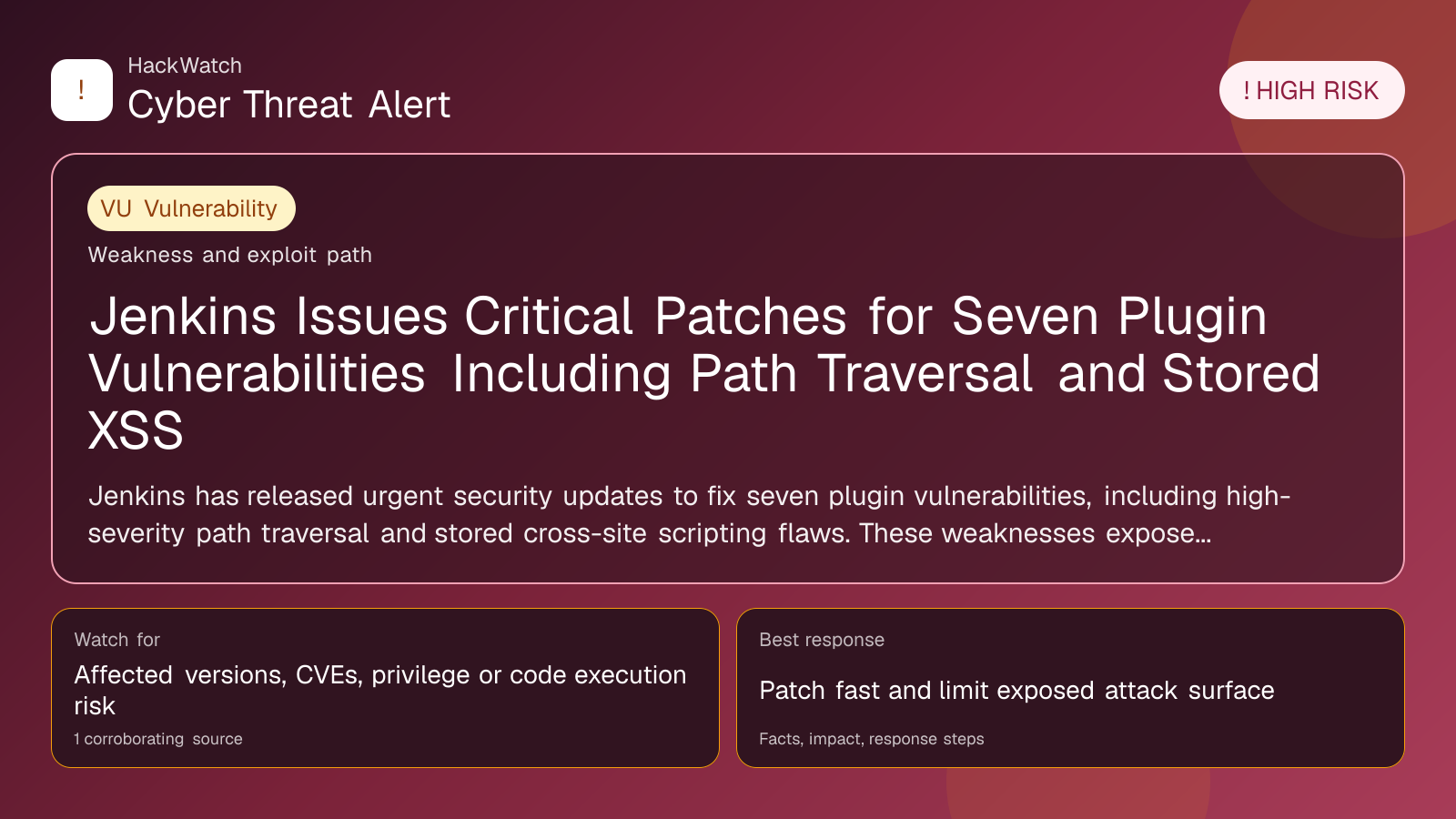
Jenkins Issues Critical Patches for Seven Plugin Vulnerabilities Including Path Traversal and Stored XSS
Vulnerability coverage focused on affected versions, exploitability and patch or mitigation decisions.

Published: Apr 30, 2026
Incident status: Resolved or patched
Corroborating sources: 1
Technical review credentials: Security+ evidence | RHCSA evidence | JNCIS-SEC evidence
Trust note:This alert is maintained under HackWatch's editorial policy, with visible source records, a named responsible editor and a correction channel for disputed facts.
The published article is checked against public sources before publication, and material corrections are reflected in the article update date.
Technical reviewer note: Marcin Pocztowski reviewed this alert on Apr 30, 2026 for server impact, affected-version evidence, privilege or code-execution claims and realistic patch priority. His remediation note follows the same discipline he would use around Juniper routers and production servers: verify scope, preserve useful logs, reduce exposed management access and only then apply the fix or compensating control supported by the 1 corroborating source.
Review our editorial policy or send corrections to [email protected].
Resolved or patched. Source coverage indicates that a fix or formal remediation has been published. Verify that updates are applied in your environment.
Jenkins has released urgent security updates to fix seven plugin vulnerabilities, including high-severity path traversal and stored cross-site scripting flaws. These weaknesses expose CI/CD environments to risks such as remote code execution and session hijacking. Administrators are advised to update plugins immediately to prevent potential exploitation.
GLOBAL, April 30, 2026, 14:24 UTC
- Jenkins patches seven plugin vulnerabilities, including critical path traversal and stored cross-site scripting (XSS).
- Flaws could allow remote code execution and session hijacking in CI/CD pipelines.
- Immediate plugin updates are recommended to mitigate attack risks.
Jenkins, a leading automation server for continuous integration and deployment, has issued security updates addressing seven plugin vulnerabilities. Among these, a path traversal flaw stands out for its severity, enabling attackers to access sensitive files outside intended directories.
The vulnerabilities also include stored cross-site scripting (XSS) issues, which allow malicious scripts to persist in Jenkins web pages. Such scripts can hijack user sessions or execute unauthorized commands within the Jenkins environment.
These security gaps threaten organizations relying on Jenkins for software delivery pipelines. Exploiting them could lead to remote code execution, compromising the underlying servers and potentially the broader infrastructure.
Jenkins’ official security advisory stresses the urgency for administrators to apply plugin updates without delay. Failure to patch promptly leaves systems vulnerable to automated exploitation attempts.
Plugins extend Jenkins’ core functionality but also enlarge the attack surface. This cluster of flaws highlights the importance of vigilant plugin management and timely patching in CI/CD workflows.
The path traversal vulnerability allows crafted requests to retrieve files beyond the plugin’s scope, risking exposure of credentials, configurations, or other sensitive data.
Multiple plugins suffer from stored XSS flaws, enabling attackers to inject persistent malicious code. This can result in session hijacking or manipulation of Jenkins operations.
While the Jenkins platform itself remains stable, these third-party plugin vulnerabilities underscore the risks inherent in external components. Organizations should audit installed plugins and remove those unnecessary or unsupported.
Security researchers and Jenkins maintainers continue monitoring the situation. No widespread attacks have been reported yet, but the vulnerability window remains open until patches are applied.
Administrators are advised to verify successful plugin updates and monitor Jenkins logs for suspicious activity.
Going forward, Jenkins users should implement stricter controls over plugin usage, including vetting, limiting privileges, and enforcing least privilege principles.
The full advisory with patch details is available on the official Jenkins website.
Delaying updates increases the risk of compromise, as threat actors may develop exploits targeting unpatched Jenkins instances.
In summary, Jenkins’ recent security patches address critical vulnerabilities that jeopardize CI/CD pipeline integrity. Immediate action is necessary to prevent potential breaches.
---
Key Actions for Jenkins Users:
- Identify if your Jenkins instance uses any affected plugins.
- Update all vulnerable plugins to the latest versions immediately.
- Restrict Jenkins server access to trusted networks.
- Monitor Jenkins logs and user activity for anomalies.
- Remove or disable non-essential plugins to reduce exposure.
---
Security Best Practices:
- Apply plugin updates promptly as they become available.
- Limit Jenkins server access to authorized personnel.
- Enable strong authentication methods, including multi-factor authentication.
- Regularly audit plugins and eliminate outdated or unsupported ones.
- Use network segmentation to isolate Jenkins from critical systems.
---
As of mid-2026, Jenkins continues enhancing its security measures by improving plugin vetting and automated vulnerability detection. Users are encouraged to stay current with Jenkins releases and integrate security best practices into their CI/CD processes.
Sources used for this article
cybersecuritynews.com