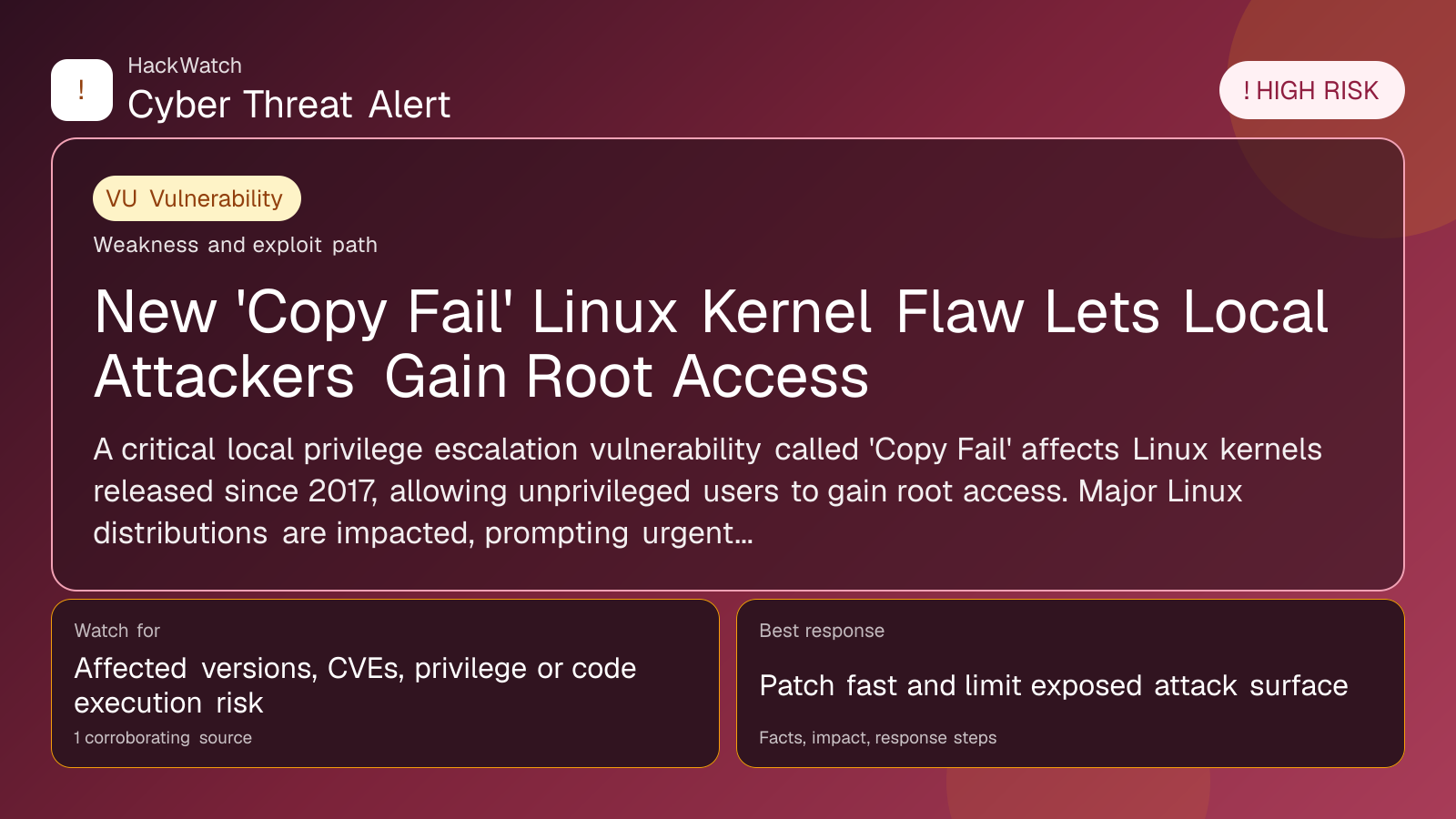
New 'Copy Fail' Linux Kernel Flaw Lets Local Attackers Gain Root Access
Vulnerability coverage focused on affected versions, exploitability and patch or mitigation decisions.

Published: Apr 30, 2026
Incident status: Mitigation available
Corroborating sources: 1
Technical review credentials: Security+ evidence | RHCSA evidence | JNCIS-SEC evidence
Trust note:This alert is maintained under HackWatch's editorial policy, with visible source records, a named responsible editor and a correction channel for disputed facts.
The published article is checked against public sources before publication, and material corrections are reflected in the article update date.
Technical reviewer note: Marcin Pocztowski reviewed this alert on Apr 30, 2026 for server impact, affected-version evidence, privilege or code-execution claims and realistic patch priority. His remediation note follows the same discipline he would use around Juniper routers and production servers: verify scope, preserve useful logs, reduce exposed management access and only then apply the fix or compensating control supported by the 1 corroborating source.
Review our editorial policy or send corrections to [email protected].
Mitigation available. Mitigation guidance or a workaround is available, but defenders should still verify rollout status and exposure.
A critical local privilege escalation vulnerability called 'Copy Fail' affects Linux kernels released since 2017, allowing unprivileged users to gain root access. Major Linux distributions are impacted, prompting urgent patching recommendations to prevent system takeover.
GLOBAL, April 30, 2026, 14:14 UTC
- "Copy Fail" targets Linux kernels dating back to 2017
- Enables local attackers to escalate privileges to root
- Major distributions including Ubuntu, Debian, Fedora, and CentOS affected
A recently disclosed vulnerability named "Copy Fail" exposes Linux systems running kernels from 2017 onward to local privilege escalation attacks. The flaw stems from improper error handling in kernel memory copy operations, allowing unprivileged users to execute code with root privileges.
Security researchers published a working exploit on April 30, 2026, demonstrating how attackers can leverage the flaw to gain full administrative control. The vulnerability bypasses standard kernel restrictions due to inadequate error checks during memory copying.
This issue is urgent because countless servers, desktops, and embedded devices worldwide run affected kernels. Attackers with local access—whether via compromised accounts or physical presence—can exploit this to seize control, risking data breaches, system disruption, and lateral movement within networks.
Leading Linux distributions such as Ubuntu, Debian, Fedora, and CentOS have acknowledged the vulnerability. Some have issued patches or advisories recommending immediate updates. Nonetheless, many systems remain vulnerable pending patch deployment.
Given Linux's role in critical infrastructure, cloud platforms, and enterprise environments, the vulnerability poses significant risks beyond individual machines. Successful exploitation could compromise key servers and undermine organizational security.
System administrators should verify kernel versions and apply vendor patches without delay. Where patching is not immediately possible, limiting local user access and monitoring system logs for anomalies can reduce exposure.
The flaw highlights persistent challenges in securing complex kernel memory management code. It also reinforces the need for timely patching and layered security measures to mitigate privilege escalation risks.
Linux kernel developers are reviewing the affected code to prevent similar vulnerabilities. Users should watch for further advisories and updates throughout 2026.
Risks remain for legacy and embedded systems that may not receive fixes, leaving them vulnerable indefinitely. Attackers might also develop new exploit variants to circumvent mitigations, requiring ongoing vigilance.
Users can check their kernel version and consult distribution security advisories to confirm exposure. Prompt patch application remains the most effective defense.
In sum, the "Copy Fail" vulnerability demands immediate action from Linux users and administrators to patch systems and restrict local access until updates are applied.
For detailed guidance, refer to your Linux distribution's official security advisories.
Source: https://www.bleepingcomputer.com/news/security/new-linux-copy-fail-flaw-gives-hackers-root-on-major-distros/
Sources used for this article
BleepingComputer