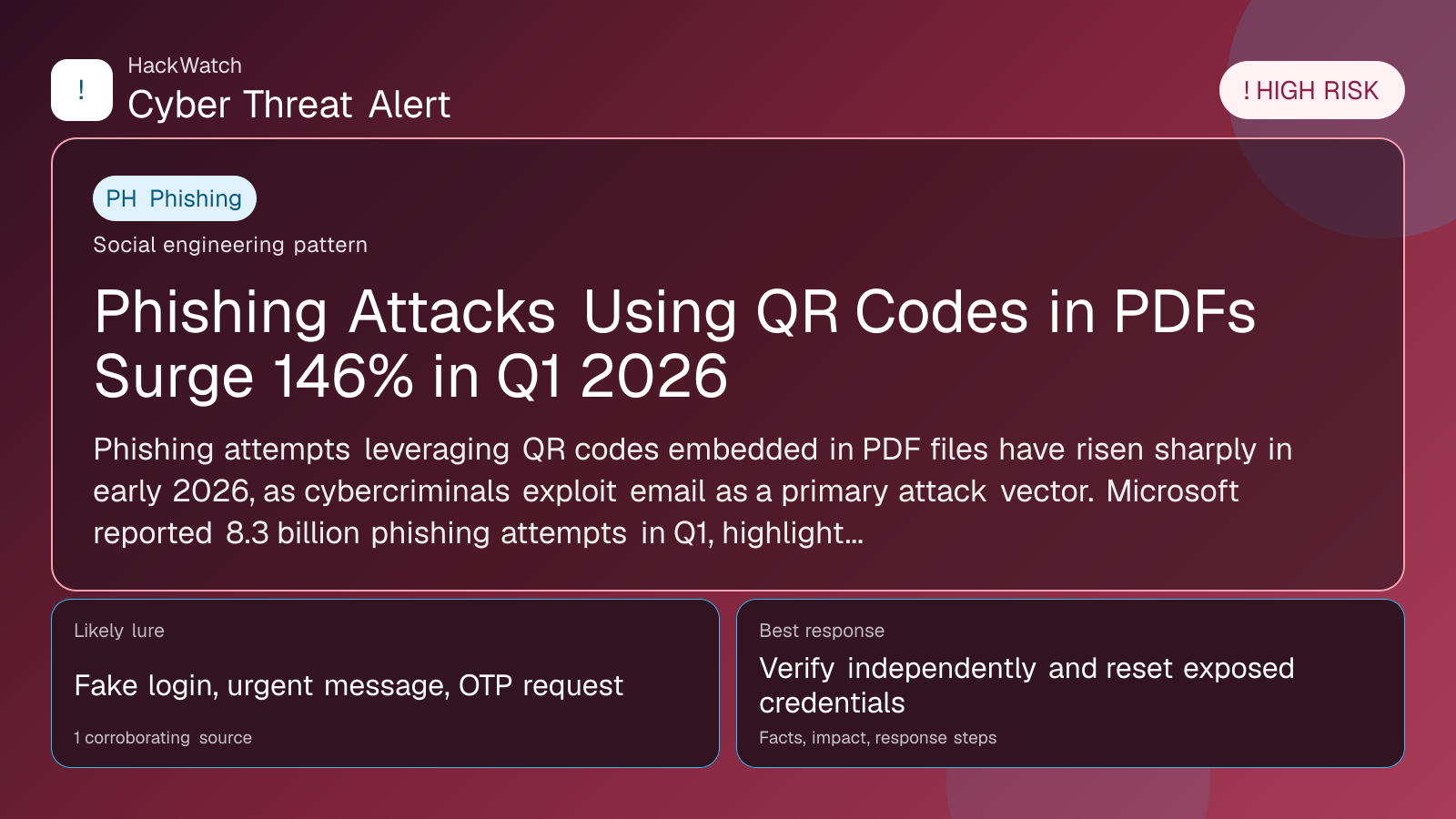
Phishing Attacks Using QR Codes in PDFs Surge 146% in Q1 2026
Verification-lure coverage focused on fake messages, cloned pages and account defense steps.

By: Artur Ślesik
Published: May 02, 2026
Incident status: Active threat
Corroborating sources: 1
Technical review credentials: Security+ evidence | RHCSA evidence | JNCIS-SEC evidence
Trust note:This alert is maintained under HackWatch's editorial policy, with visible source records, a named responsible editor and a correction channel for disputed facts.
The published article is checked against public sources before publication, and material corrections are reflected in the article update date.
Technical reviewer note: Marcin Pocztowski reviewed this alert on May 02, 2026 for server impact, affected-version evidence, privilege or code-execution claims and realistic patch priority. His remediation note follows the same discipline he would use around Juniper routers and production servers: verify scope, preserve useful logs, reduce exposed management access and only then apply the fix or compensating control supported by the 1 corroborating source.
Review our editorial policy or send corrections to [email protected].
Active threat. The incident should still be treated as active until confirmed mitigation or patch adoption is verified.
Phishing attempts leveraging QR codes embedded in PDF files have risen sharply in early 2026, as cybercriminals exploit email as a primary attack vector. Microsoft reported 8.3 billion phishing attempts in Q1, highlighting evolving tactics to evade detection.
GLOBAL, May 2, 2026, 22:09 UTC
Phishing attacks that use QR codes embedded in PDF documents increased by 146% during the first quarter of 2026, according to recent data from Microsoft Threat Intelligence.
Email remains the dominant channel for cyberattacks, with Microsoft detecting 8.3 billion phishing attempts worldwide in the first three months of the year. Attackers are increasingly embedding malicious QR codes in PDFs to bypass traditional security filters.
QR codes in phishing emails redirect victims to fraudulent websites designed to steal credentials or deliver malware. This method complicates detection because the QR code contents are not easily scanned by automated security tools.
The rise in QR code phishing reflects attackers’ adaptation to heightened email security measures. By hiding malicious links behind QR codes in seemingly innocuous PDF attachments, threat actors exploit users’ trust and curiosity.
Security analysts warn that this trend poses a significant risk to both individuals and organizations, as users may unknowingly scan QR codes with their smartphones, leading to credential theft or device compromise.
Microsoft’s report underscores the need for enhanced user awareness and technical controls. Organizations should consider implementing email filtering solutions capable of inspecting embedded QR codes and educating employees about the dangers of scanning codes from unknown sources.
Users are advised to verify the legitimacy of any PDF attachments received via email, especially those containing QR codes. Avoid scanning QR codes from unsolicited messages or unfamiliar senders.
This surge in QR code phishing coincides with a broader escalation in phishing volume and sophistication globally, emphasizing the persistent challenge of securing email communications.
While QR code phishing is rising rapidly, traditional phishing methods remain prevalent, requiring ongoing vigilance and layered defense strategies.
The evolving threat landscape suggests that attackers will continue to innovate ways to circumvent detection, making proactive cybersecurity measures essential.
Security teams should monitor for unusual QR code activity and consider deploying mobile security solutions that can analyze QR code destinations before allowing access.
Failure to address this emerging vector could lead to increased incidents of identity theft, financial fraud, and network breaches.
As phishing tactics diversify, organizations and individuals must remain alert to new forms of attack beyond conventional email links and attachments.
Microsoft’s findings highlight the critical importance of integrating behavioral analysis and advanced scanning technologies into email security frameworks.
The rapid growth of QR code phishing in PDFs signals a shift in attacker strategies that cybersecurity defenses must quickly adapt to mitigate risks effectively.
Source: https://www.cisoadvisor.com.br/phishing-por-qr-code-em-pdf-cresce-146-no-1o-trimestre/
Sources used for this article
cisoadvisor.com.br